Before comparing features and costs, you need to understand what you’re actually choosing
between. These are not the same product with different hosting. They are fundamentally different
architectural models.
AEM doesn’t run on magic. It runs on a carefully layered set of open standards. Understanding
those layers is the difference between being reactive (“something is broken”) and proactive (“I know
exactly what to check”).
OSGi is beautiful, until it isn’t. When it works, you get a hot-reloadable, loosely-coupled runtime
where services wire themselves together at startup. When it breaks, you get a cascade of bundle
failures that look completely unrelated to your change.
OSGi (Open Services Gateway initiative) is a Java-based component system. In AEM, it’s
implemented by Apache Felix. The entire AEM application — including your custom code — runs
as a set of OSGi bundles inside this container.
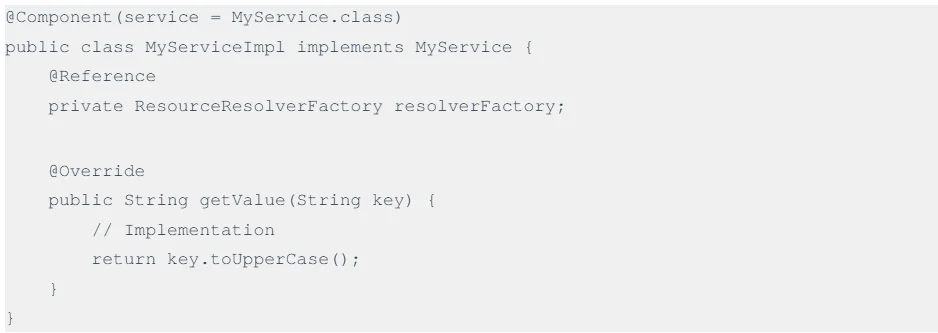
A service is a Java interface implemented by one or more bundles and registered in a service
registry. Other bundles discover services through the registry — they never depend on a specific
implementation class.
A component is a Java class annotated with @Component (from the OSGi DS annotations). When
the bundle activates, OSGi DS scans these annotations and instantiates/wires components
automatically.
Every component can have a corresponding factory configuration. Configurations are stored in the
JCR repository (under /apps/config) or as .cfg.json/.config files in your project. They are
environment-aware through run modes.
Your OSGi configuration for prod is under /apps/config.prod but your run modes are set to
author,publish — not prod. Everything deploys without an error. Your production config is silently
ignored. Always validate run-mode-specific configs with the Felix console after deployment.
You update Bundle A, which exports a package that Bundle B imports. Bundle B suddenly goes from
Active to Installed state (its import is no longer satisfied during the update window). Bundle C
depends on a service from Bundle B — it also goes down. One bundle update causes three services
to disappear simultaneously. The Felix console’s Bundles view is your first diagnostic tool.
The Java Content Repository (JCR) is the storage backbone of AEM. Unlike a relational database
with rows and columns, JCR stores everything — content, configuration, templates, component
code, user data — as a hierarchy of nodes and properties.
The JCR tree has several standard root paths you’ll work with every day:
Every node has a primary type that defines what properties and child nodes it can have. Common
node types in AEM include:
Apache Oak — The JCR Implementation
Apache Oak is the JCR 2.0 implementation powering AEM 6.x and AEM as a Cloud Service. Oak
supports two storage backends:
Sling Resource Resolution and the JCR
Sling maps incoming URLs to JCR nodes. When a request arrives for /content/my-site/home.html,
Sling walks the JCR tree to find a node at /content/my-site/home, then looks for the component
referenced by that node’s sling:resourceType property to render it.
Apache Sling is the web framework that bridges the JCR and your component code. Its core insight
is deceptively simple: every URL maps to a resource in the JCR, and every resource has a type
that determines how it’s rendered.
A Sling URL follows a specific pattern that experienced AEM developers read like code:
Sling’s open selector model is powerful but dangerous. An attacker requesting
/content/page.infinity.json can dump an entire JCR subtree as JSON. Always configure your Sling
URL mappings and Dispatcher rules to whitelist only the selectors your application exposes. The
/system/console/slinglog viewer will show you every selector hit in real time.
The Sling Request Pipeline
When a request arrives, Sling processes it through a fixed pipeline:
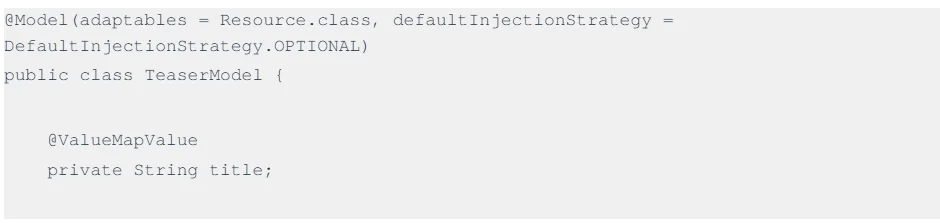
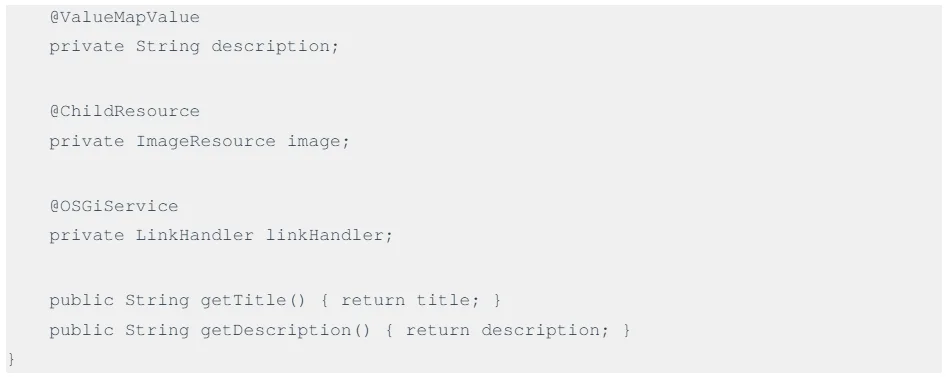
Sling Models are Plain Old Java Objects (POJOs) annotated to automatically inject resource
properties and OSGi services. They’re the recommended way to write business logic in AEM.
HTL replaced JSP as the recommended server-side templating language for AEM. If you’re still
writing Java directly in your template files, you’re doing it wrong — and you’re creating a security
risk.
data-sly-use — Load a Sling Model
data-sly-list — Iterate a Collection
data-sly-test — Conditional Rendering
data-sly-include / data-sly-resource — Composition
AEM is not a black box. It’s six well-documented open-source technologies stacked on top of each
other, each with a specific responsibility, a standard API, and a console for introspection.
The developers who excel in AEM are not the ones who memorize the most APIs. They’re the ones
who understand the shape of the system — who know that a missing OSGi configuration in a run-
mode folder is why prod behaves differently than dev, that a Dispatcher filter rule is why a perfectly
valid URL returns 403, and that a Sling resourceType miss is why a component renders nothing.
You now have that map. The next step is to open the Felix console on a real AEM instance and
start exploring. The architecture is all there, visible and interactive, waiting for you to poke at it.